
Beyond OCR: Engineering a Layout-Aware Indic PDF Translation Pipeline
Engineering challenges often emerge at the intersection of language, structure and automation. One such challenge involved building a system capable of transforming general-language PDFs into Indic languages without losing layout fidelity, structural alignment or visual consistency.
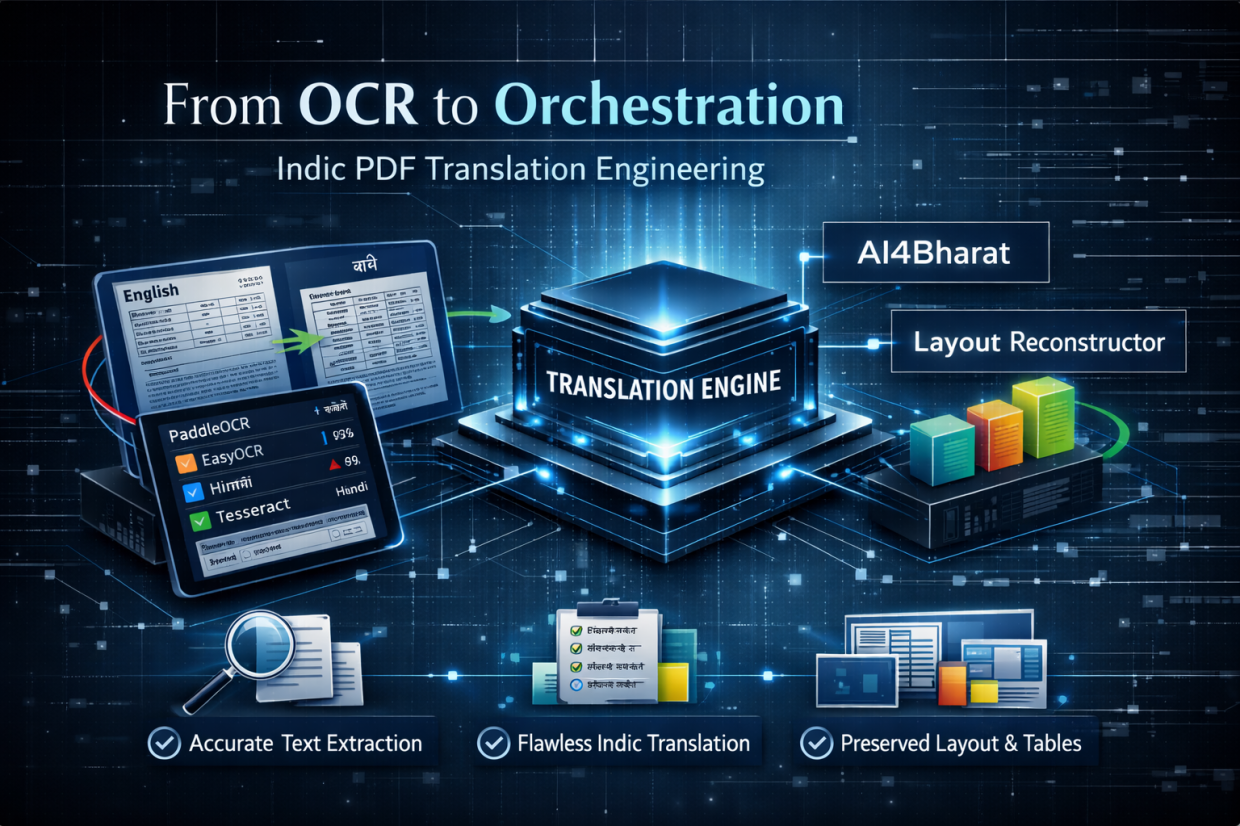
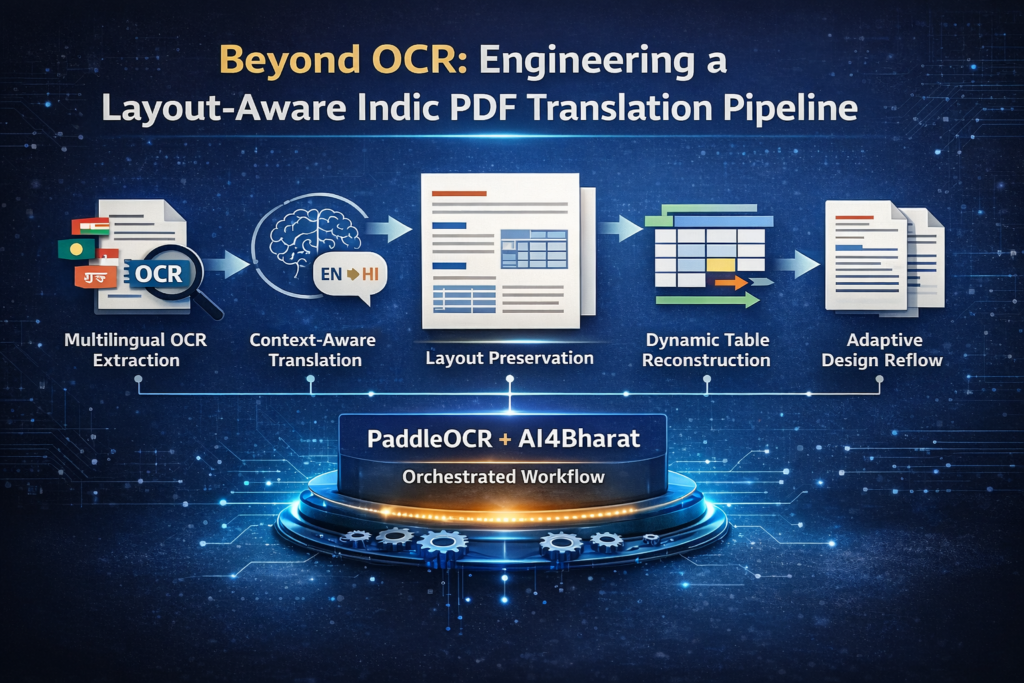
On the surface, this sounds like an OCR and translation task. In reality, it became an orchestration problem involving multiple OCR engines, context-aware translation models and layout reconstruction logic working together as a single intelligent workflow.
This project represents a shift from simple text extraction toward layout-aware document intelligence, where preserving meaning and preserving structure carry equal importance.
The Engineering Objective
The core goal was not merely to translate text, but to recreate documents in Indic languages while maintaining the original design integrity.
The system needed to:
- Extract structured content from PDFs using multiple OCR engines
- Translate English content into Indic languages such as Hindi
- Preserve bounding boxes and layout positions
- Reconstruct tables dynamically based on translated text size
- Prevent overlapping caused by language expansion
Unlike traditional translation pipelines, this required deep coordination between AI models and document reconstruction logic, an approach aligned with Swayalgo’s focus on practical AI engineering.
Evaluating OCR Models in Production Contexts
During development at Swayalgo Technologies Pvt Ltd, multiple OCR frameworks were tested:
- PaddleOCR
- EasyOCR
- Tesseract OCR
Each offered unique advantages, but real-world structured documents revealed clear differences.
Tesseract OCR – performed well for lightweight extraction but struggled with complex layouts.
EasyOCR – provided multilingual flexibility but lacked stability in table-heavy documents.
PaddleOCR – delivered consistent bounding box detection and reliable structure awareness, making it the strongest choice for production workflows.
The decision to standardize on PaddleOCR came from evaluating not just accuracy but reconstruction reliability.
Real-World Challenges and Architectural Decisions
Indic Language Expansion
One of the most complex engineering challenges involved text expansion. Indic translations often produce longer sentence structures compared to English. When inserted into fixed coordinates, this created:
- Text collisions
- Broken table alignment
- Layout distortion
Rather than forcing translated text into rigid boundaries, the system recalculated layout structures dynamically.
Context-Aware Translation
Early experiments translating line-by-line resulted in poor semantic quality. Translation models require full context, not fragmented lines.
To solve this, the pipeline reconstructs logical sentences before translation. This architectural change significantly improved accuracy and readability.
Dynamic Table Reconstruction
Tables proved to be the most sensitive element. Instead of treating tables as static geometry, the system rebuilds them based on translated content size, ensuring alignment remains visually correct even after language transformation.
Pipeline Architecture at Swayalgo
The implemented workflow follows a structured orchestration model:
Step 1 — Page Banking
Each page is indexed with metadata including:
- Page dimensions
- Text coordinates
- Table regions
- Image positions
This creates a structural blueprint for reconstruction.
Step 2 — OCR Extraction
Using PaddleOCR, the system extracts text blocks and layout data, preserving positional information required for later stages.
Step 3 — Sentence Reconstruction
Extracted lines are merged into context-aware text segments. Structural noise is removed so that translation models receive meaningful input.
Step 4 — Indic Translation with AI4Bharat
The AI4Bharat model was selected for its strong performance in Indian language translation. Its contextual understanding allowed the system to maintain semantic accuracy across longer sentence structures.
Step 5 — Layout-Aware Placement
Translated text is repositioned using recalculated bounding regions. If content exceeds available space, additional pages are generated automatically preventing overlap without manual adjustment.
Step 6 — Structural Reconstruction
Tables, images and metadata elements are rebuilt while preserving original design intent, ensuring the final document mirrors the source layout.
Why PaddleOCR Emerged as the Preferred Engine
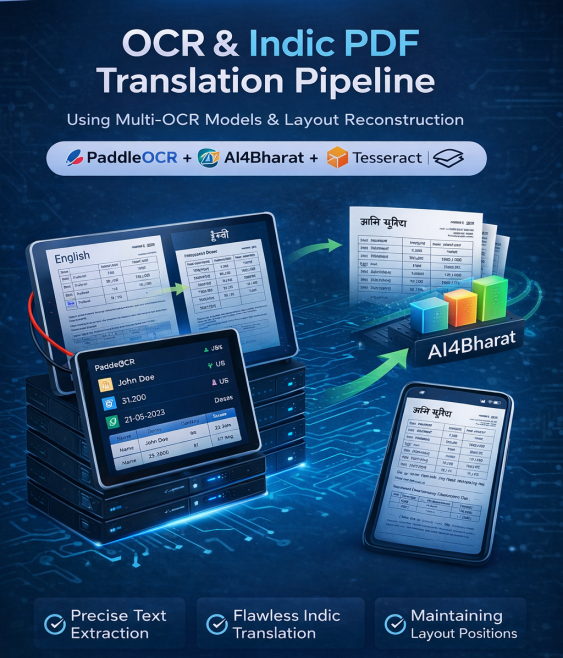
Throughout iterative testing at Swayalgo, PaddleOCR consistently demonstrated:
- Accurate layout detection
- Strong multilingual performance
- Reliable table extraction
Its balance between precision and flexibility made it the most suitable choice for layout-preserving translation workflows.
Lessons from Building Layout-Aware AI Systems
This project reinforced several broader engineering principles:
- OCR accuracy alone is insufficient without structural intelligence
- Translation pipelines must prioritize context over speed
- Indic language workflows require adaptive layout logic
- AI systems must be orchestrated, not simply connected
Most importantly, real-world AI engineering is less about isolated models and more about how those models interact within a controlled architecture.